
How to Spot a Fake Classified Ad — Warning Signs Every User Must Know
Updated: September 24, 2026
Why Fake Classified Ads Are Still a Major Problem in 2026
Free classified platforms attract two types of users — genuine people looking for real connections, rentals, services, or pets, and scammers who use the same platforms to extract money, personal information, or both from unsuspecting users. Eight years after the closure of Backpage and the removal of Craigslist personals, scam listings have not disappeared. They have evolved.
The good news is that fake classified ads follow consistent, recognizable patterns. Once you know what to look for, identifying a fake listing takes less than thirty seconds. This guide covers every warning sign across every major classified category — personal ads, rental listings, service offers, and pet classifieds — so you can protect yourself every time you browse.
The Most Common Types of Classified Ad Scams in 2026
Before covering the specific warning signs, it helps to understand what scammers are actually trying to accomplish. The most common classified ad scams fall into four categories:
- Advance payment scams — the fake lister asks for a deposit, gift card, or wire transfer before any meeting or transaction occurs. Once you pay, they disappear.
- Personal information harvesting — the fake lister is not after money directly but collects your phone number, email, location, or financial details to use or sell.
- Bait and switch — the listing is real but misrepresented. You show up to view a rental and find something completely different, then get pressured into a deposit anyway.
- Catfishing in personal ads — the person behind the ad is not who the photos suggest. They maintain the deception long enough to request money for a "crisis" or "travel to meet you."
Every warning sign in this guide connects back to one of these four patterns. Once you understand the goal behind the scam, the individual tactics become much easier to identify.
How to Spot a Fake Personal Ad
The Photos Look Too Perfect
Genuine personal ad photos look like real people took them with a phone — imperfect lighting, natural backgrounds, ordinary settings. Photos that look like professional model shoots, magazine covers, or glamour photography are almost always stolen from social media or stock image sites.
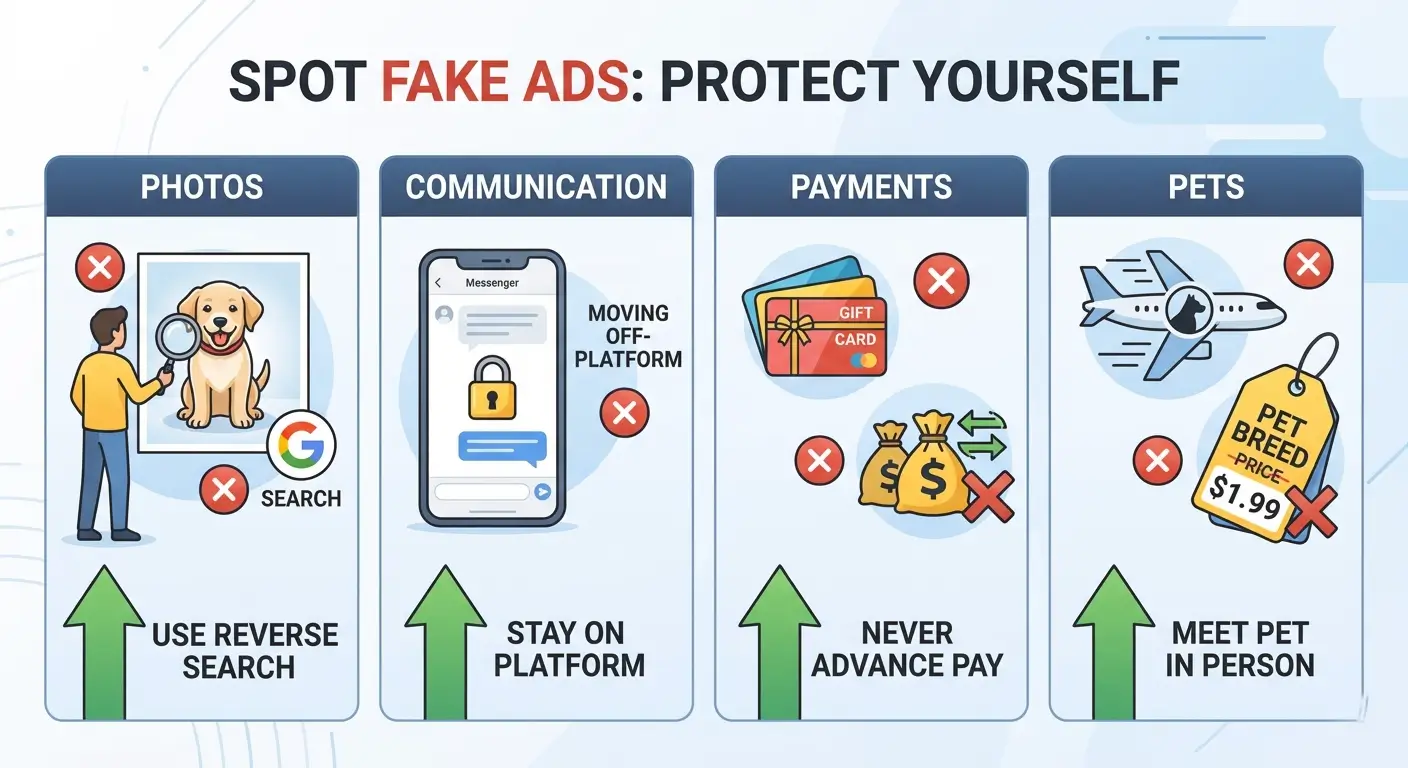
If you are suspicious about a photo, use Google Reverse Image Search or TinEye. Right-click the photo, select "Search image" or save it and upload it to images.google.com. If the same photo appears under a different name on multiple sites, the listing is fake. This takes under a minute and is the single most reliable way to verify a personal ad photo.
The Description is Vague or Copied
Fake personal ads often have descriptions that could apply to anyone. Phrases like "I'm a simple girl looking for a real man" or "I want someone who knows how to treat a lady right" with no specific details, no location reference, and no genuine personality coming through are red flags. Real people write real descriptions — even awkward or imperfect ones have a specific voice.
If the description reads like it was translated from another language, contains unusually formal phrasing, or feels copy-pasted and generic, treat it with caution.
They Move to External Platforms Immediately
A genuine person who posts a classified ad is comfortable communicating through the platform for at least the initial exchange. Scammers want to move you off the platform immediately — to WhatsApp, Telegram, a specific text number, or a third-party site — because classified platforms have moderation and they cannot control what happens there.
If the first response to your message is "text me at this number" or "add me on Telegram" before any real conversation has occurred, stop. This is one of the most consistent behaviors across every type of fake classified ad.
They Ask for Money Before Meeting
No genuine personal connection requires a financial transaction before a first meeting. Any request for gift cards, wire transfers, Venmo, Zelle, or Cash App payments from someone you have not met in person — regardless of how compelling the story — is a scam. Common stories include needing money for a plane ticket to visit you, a medical emergency, a phone bill, or verification fees. None of these are legitimate.
The Conversation Escalates Unnaturally Fast
Scammers who run romance or personal ad scams are trained to create emotional attachment quickly. If someone you have never met is expressing deep feelings, calling you their soulmate, or making plans for your future together within the first few messages — slow down. Genuine connections develop at a normal human pace. Accelerated emotional intimacy in a classified ad context is a manipulation technique.
How to Spot a Fake Rental Listing
The Price is Significantly Below Market Rate
This is the most reliable single indicator of a rental scam. If a three-bedroom house in a desirable neighborhood is listed at half the going market rate, it is almost certainly fake. Scammers use below-market pricing to generate a high volume of desperate inquiries from people who want to believe they have found a great deal.
Before responding to any rental listing, spend five minutes checking comparable listings in the same area on the same platform. If the price is more than 25% below similar units, investigate carefully before engaging.
The Landlord Cannot Show You the Property in Person
Legitimate landlords and property owners can arrange an in-person viewing. Fake rental listers always have a reason why they cannot show you the property — they are overseas, traveling for work, with the military, doing missionary work, or dealing with a family emergency. They will offer to mail you the keys after you send a deposit. This is a scam 100% of the time.
If you cannot physically walk through a rental before paying any money, do not pay any money. This rule has no exceptions.
They Ask for Payment Before You Sign Anything
Legitimate rental transactions follow a standard sequence: view the property, review and sign a lease, pay a deposit and first month. Any request to send money before viewing the property or signing a lease agreement is a warning sign. Gift card payments, wire transfers, or cryptocurrency payments for rental deposits are always scams — these payment methods are used specifically because they cannot be reversed.
The Listing Photos Look Too Professional or Generic
Many fake rental listings use photos lifted from real estate websites, interior design blogs, or previous legitimate listings. The photos will often show a perfectly staged, spotlessly clean space that does not match the described price or neighborhood. Run the photos through Google Reverse Image Search. If they appear on Zillow, Realtor.com, or any other property site under a different address, the listing is fake.
The Communication Has Spelling and Grammar Issues
Many rental scams are operated from outside the United States. The responses you receive will often have unusual phrasing, repeated grammatical errors, or sentences that feel machine-translated. This does not apply to every case — but combined with other warning signs, poor grammar in landlord communications is worth noting.
How to Spot a Fake Service Listing
No Verifiable Business Information
Legitimate service providers have some form of verifiable presence — a phone number that rings, a business name that can be searched, reviews from previous clients, or a social media presence showing their work. A service listing with only a generic description, no business name, no photos of previous work, and a contact method that leads nowhere is a red flag.
They Request Full Payment Upfront Before Any Work Begins
Genuine service providers may request a deposit for larger jobs — this is standard practice. Full payment demanded before any work begins, especially via non-reversible payment methods like wire transfer, gift cards, or cryptocurrency, is a scam pattern. Pay a deposit only after meeting the provider in person. Pay the balance only after the work is completed to your satisfaction.
The Price is Unusually Low for the Service Described
A cleaning service offering whole-home cleans for $20, a moving company quoting far below market rate, or a contractor with significantly lower prices than every competitor in the area are all worth approaching carefully. Predatory pricing in service listings is used either to generate upfront deposits that disappear or to bait and switch into higher charges once work has started.
How to Spot a Fake Pet Listing
The Seller Cannot Meet in Person
Legitimate pet sellers and adopters can arrange an in-person meeting, ideally at the animal's current location so you can see how it lives and verify its health directly. Fake pet listings always involve shipping — the seller claims to be in another city or state and offers to ship the animal after you send a deposit. Animals cannot be legitimately purchased this way without substantial documentation and regulated shipping processes. Any pet listing that leads immediately to a shipping conversation is fake.
The Price is Too Low for the Breed Described
Pure-bred puppies from legitimate breeders have predictable market values. A French Bulldog or Golden Doodle listed at $150 is not a deal — it is bait. The low price generates inquiries, and once you express interest the scammer introduces additional fees for "shipping insurance," "veterinary health certification," or "pet travel crates" that must be paid before the animal arrives. The animal never arrives.
The Photos Show a Perfect Animal in a Studio Setting
Genuine pet photos look like someone took them at home — natural backgrounds, ordinary lighting, the animal in its actual living environment. Professional-quality photos of an animal against a clean backdrop, or photos where the same animal appears with different owners in different settings, are often stolen from legitimate breeders or pet websites.
They Push You to Decide Quickly
Scammers use artificial urgency to prevent you from thinking clearly or doing research. "I have three other people interested and the first one to send a deposit gets the puppy" is a pressure tactic designed to make you act before you verify anything. Legitimate sellers are happy to give you time to ask questions, verify their information, and arrange a viewing. Any seller who pressures you to commit immediately should be treated with extreme caution.
General Warning Signs That Apply to Every Classified Category
Beyond the category-specific signs above, these red flags apply to any classified ad you encounter:
- Requests for gift cards as payment — no legitimate transaction of any kind uses gift cards as payment. This is always a scam.
- Requests for wire transfers or cryptocurrency before any in-person meeting — these payment methods are used because they cannot be reversed or traced.
- Pressure to act immediately — urgency is a manipulation tool. Genuine sellers, landlords, and service providers will give you time.
- Responses that do not address what you actually asked — scammers often use copy-paste responses that are not specific to your message. If the reply feels like it could have been sent to anyone, it probably was.
- Requests for personal information before establishing any trust — your home address, workplace, financial account details, or ID documents should never be shared with someone you have not verified in person.
- Contact that moves off the platform immediately — moderated platforms offer protection. Scammers want to move you off them.
What to Do If You Encounter a Fake Listing
If you identify a fake or suspicious listing on BackpageSeek, use the report function on the listing page. BackpageSeek's moderation team reviews flagged listings and removes confirmed fake content. Reporting a suspicious listing takes less than a minute and protects other users in your city who might encounter the same ad.
If you have already been scammed through a classified ad, file a report with the Federal Trade Commission at ftc.gov/complaint and your local police department. While recovery of lost money is difficult, reporting helps law enforcement track patterns and take action against repeat offenders.
How BackpageSeek Protects Users From Fake Listings
BackpageSeek uses active human moderation to review listings before they appear publicly. Phone numbers are protected by hCAPTCHA verification — a viewer must complete a verification step before any contact information is revealed, which significantly reduces automated spam and bot-generated fake listings. Users can report suspicious listings directly from the ad page, and reported content is reviewed and removed when confirmed as fraudulent.
No platform can eliminate every fake listing — but active moderation, phone verification requirements for posting, and a user reporting system working together create a significantly safer environment than unmoderated alternatives.
The Bottom Line — Trust Your Instincts and Verify Before You Pay
The single most effective protection against classified ad scams is simple: never send money to someone you have not met in person, for a property you have not physically visited, or for a service that has not been delivered. Every scam on this list requires you to pay before any of those things happen. Refuse that step and the scam cannot proceed.
Use Google Reverse Image Search on photos that seem too perfect. Search the phone number or email you receive. Check comparable prices before assuming you have found a deal. And if something feels wrong, trust that feeling — it is almost always correct.
Browse real verified listings on BackpageSeek across 560+ cities in the USA, Canada, UK, and Australia. No account required to start looking.
Frequently Asked Questions — Fake Classified Ads
How do I know if a classified ad is fake?
The most reliable indicators are: photos that appear on other websites under different names (check with Google Reverse Image Search), requests for payment before any in-person meeting, prices significantly below the market rate for the area, and immediate pressure to move communication off the platform. Any one of these is a warning sign. Multiple together almost always indicate a fake listing.
What payment methods do classified ad scammers use?
Scammers consistently use payment methods that cannot be reversed — gift cards (iTunes, Amazon, Google Play), wire transfers, Western Union, Zelle, Cash App, Venmo, and cryptocurrency. These are used specifically because recovery is nearly impossible once the money is sent. Legitimate classified transactions use reversible payment methods or cash exchanged in person.
Is it safe to give my phone number in a classified ad response?
On BackpageSeek, your phone number is protected by hCAPTCHA verification — others must complete a verification step to see it. When responding to others, use the platform's messaging system for initial contact until you have enough information to feel comfortable sharing personal contact details. Never share your phone number in your first message to an unknown poster.
What should I do if I was scammed through a classified ad?
Report the listing to the platform immediately using the report function. File a complaint with the Federal Trade Commission at ftc.gov/complaint. Contact your bank or payment provider as quickly as possible — some payment reversals are possible within a short window. File a report with your local police department, particularly if the amount is significant. Document all communication you had with the scammer before reporting.
Are rental listings on free classified sites safe?
Rental listings on actively moderated platforms like BackpageSeek are significantly safer than on unmoderated alternatives. The key safety rule is consistent regardless of platform: never send any payment for a rental property you have not physically visited in person with a lease agreement in hand. Any rental transaction that cannot follow this sequence should be treated as suspicious.
How can I verify if a pet listing is genuine?
Ask to visit the animal in its current home before any payment. Request vaccination records and veterinary documentation. Use Google Reverse Image Search on the photos. Legitimate breeders and private sellers will welcome your interest in verifying the animal's health and history. Any seller who cannot or will not arrange an in-person meeting before payment is almost certainly running a scam.